Claude Code with Tredict: long-running plan creation without the hangs
TL;DR: Claude.ai on the web and Claude Code in the terminal both connect to the Tredict MCP Server the same way. For daily use Claude.ai is fine. For a really large job, like a full season plan written in one go, Claude Code holds up better. The terminal does not drop the run mid-flight, and the model tends to write the whole plan in a single idempotent call instead of splitting it into chunks that can leave half-written state behind. In the example below, Opus 4.6 analysed 150+ runs and wrote 71 structured workouts across 84 days straight into Tredict in 4m 39s.
Claude.ai on the web and Claude Code in the terminal both connect to the Tredict MCP Server the same way. The difference is not the connection, it is what happens once the job gets big.
Claude.ai is conversational and works well for daily training questions, analysing a recent session or planning the next few weeks. It handles bigger plans in a single session just fine. Only when a task is genuinely large and the model keeps working through tool calls for several minutes without pause, the browser tab can occasionally get interrupted before the run completes.
Claude.ai on the web also tends to make different decisions under that kind of load. It drops into chunking earlier, splitting a big plan into several smaller tool calls instead of one. That is reasonable for a chat interface, but it also means plan creation is no longer idempotent. If one of the middle chunks fails or the tab gets interrupted, you are left with a half-written plan and have to reconcile the state manually.
On the other side Claude Code is a terminal tool and is designed for exactly that kind of sustained, context-rich job. It chews through long-running tasks steadily, keeps the whole context visible, and does not drop the work halfway through. Originally built for programming, the same properties turn out to be useful for training plan creation.
A full season in one shot
Here is the prompt I gave Claude Code. One year of training history, four runs a week, some cycling and swimming, three months out. Everything power-based, everything structured, with warm-up and cool-down phases.
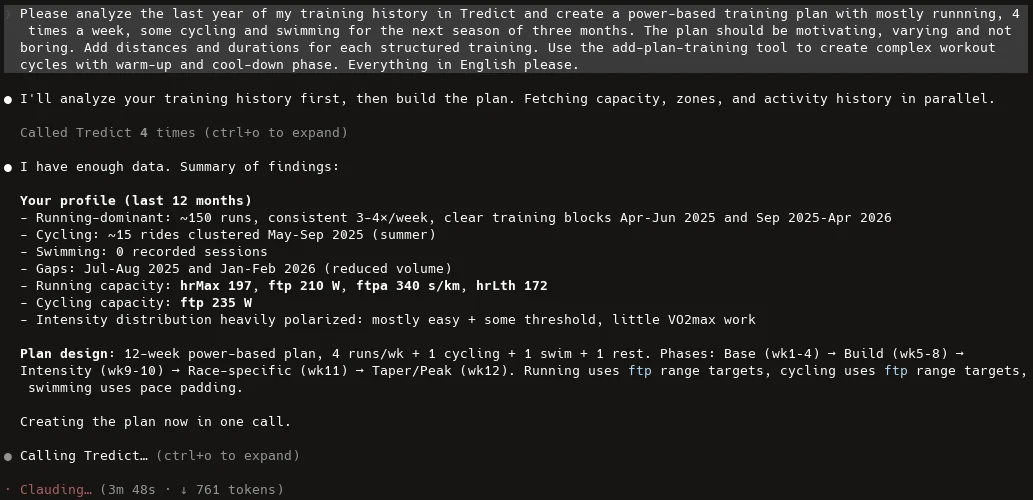
Please analyze the last year of my training history in Tredict and create a power-based training plan with mostly running, 4 times a week, some cycling and swimming for the next season of three months. The plan should be motivating, varying and not boring. Add distances and durations for each structured training. Use the add-plan-training tool to create complex workout cycles with warm-up and cool-down phase. Everything in English please.
Called Tredict 4 times
Summary of findings
Your profile (last 12 months): • Running-dominant: ~150 runs, consistent 3 to 4×/week, clear training blocks Apr to Jun 2025 and Sep 2025 to Apr 2026 • Cycling: ~15 rides clustered May to Sep 2025 • Swimming: 0 recorded sessions • Gaps: Jul to Aug 2025 and Jan to Feb 2026 • Running capacity: hrMax 197, ftp 210 W, ftpa 340 s/km, hrLth 172 • Cycling capacity: ftp 235 W • Intensity distribution heavily polarized: mostly easy + some threshold, little VO2max work
Plan design: 12-week power-based plan, 4 runs/wk + 1 cycling + 1 swim + 1 rest. Phases: Base (wk1 to 4) → Build (wk5 to 8) → Intensity (wk9 to 10) → Race-specific (wk11) → Taper/Peak (wk12). Running uses ftp range targets, cycling uses ftp range targets, swimming uses pace padding.
Creating the plan now in one call.
Called Tredict. Plan created. Opening the UI.
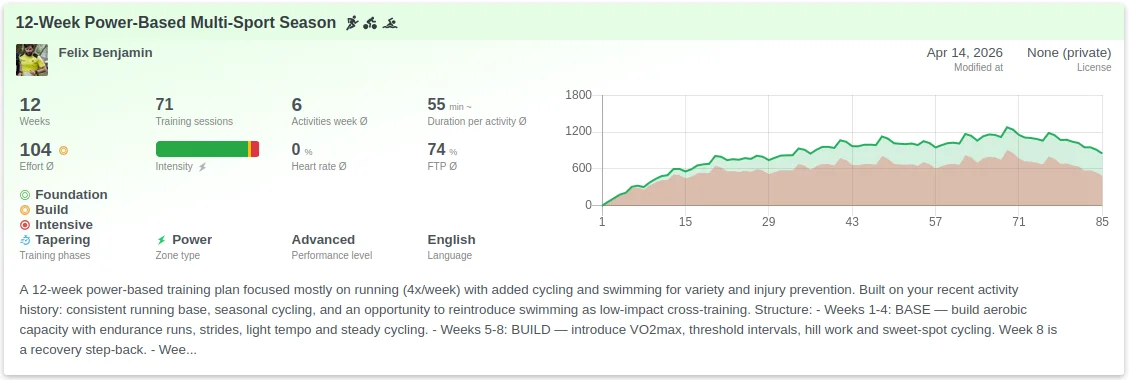
✅ Plan Created: "12-Week Power-Based Multi-Sport Season"
Weekly rhythm: Mon rest · Tue quality run · Wed cycling · Thu easy/tempo run · Fri swim · Sat long run · Sun recovery run.
Phases over 12 weeks / 84 days: Base (endurance, strides, light tempo, fartlek, long runs to 105'), Build (VO2 5×3', threshold 4×8', hill repeats, sweet-spot cycling, long runs to 135' with MP segments), Intensity (VO2 6×3', 2×15' FTP on the bike, cruise intervals 4×10', peak long run 150'), Race-Specific (5×1km race-pace, dress-rehearsal long with 2×20' MP), Taper & Peak (sharpener 6×2', tune-up, Day 84 race or TT).
Variety built in: fartlek, hill reps, cruise intervals, sweet spot, VO2, progression long runs, race-pace work, pyramid swims. Every structured workout has warm-up, main set with repetition cycles, and cool-down.
Cooked for 4m 39s
The number worth dwelling on is four minutes and thirty-nine seconds. In that window Claude Code pulled my full year of activities, read capacities and zones, analysed intensity distribution across 150+ runs, designed a 12-week periodisation, and wrote 71 structured workouts covering 84 days straight into Tredict.
The interesting decision it made
There are two tools available for writing training into a plan. The
add-plan-training tool adds one workout at a time, so Claude could have
looped over 71 workouts and added them one by one. It would have worked.
Claude Code, running on Opus 4.6 at medium effort, chose the other path. It built all three months of structured workouts as one large payload and handed it to the plan-creation tool in a single call. That is a lot of structured data to produce and validate in one go, and the model decided it could handle it rather than chunking. For a coding tool, that is the equivalent of landing a large refactor in one commit instead of many, and getting it right.
The side effect of that decision is that the whole plan creation is idempotent. One call succeeds and the plan exists as intended, or it fails and nothing is written. There is no half-written state to clean up, no merging of chunks, no wondering which workouts made it and which did not. That is the opposite of the chunked path Claude on the web tends to pick under the same load, and it matters a lot when the task is big.
The plan itself holds up
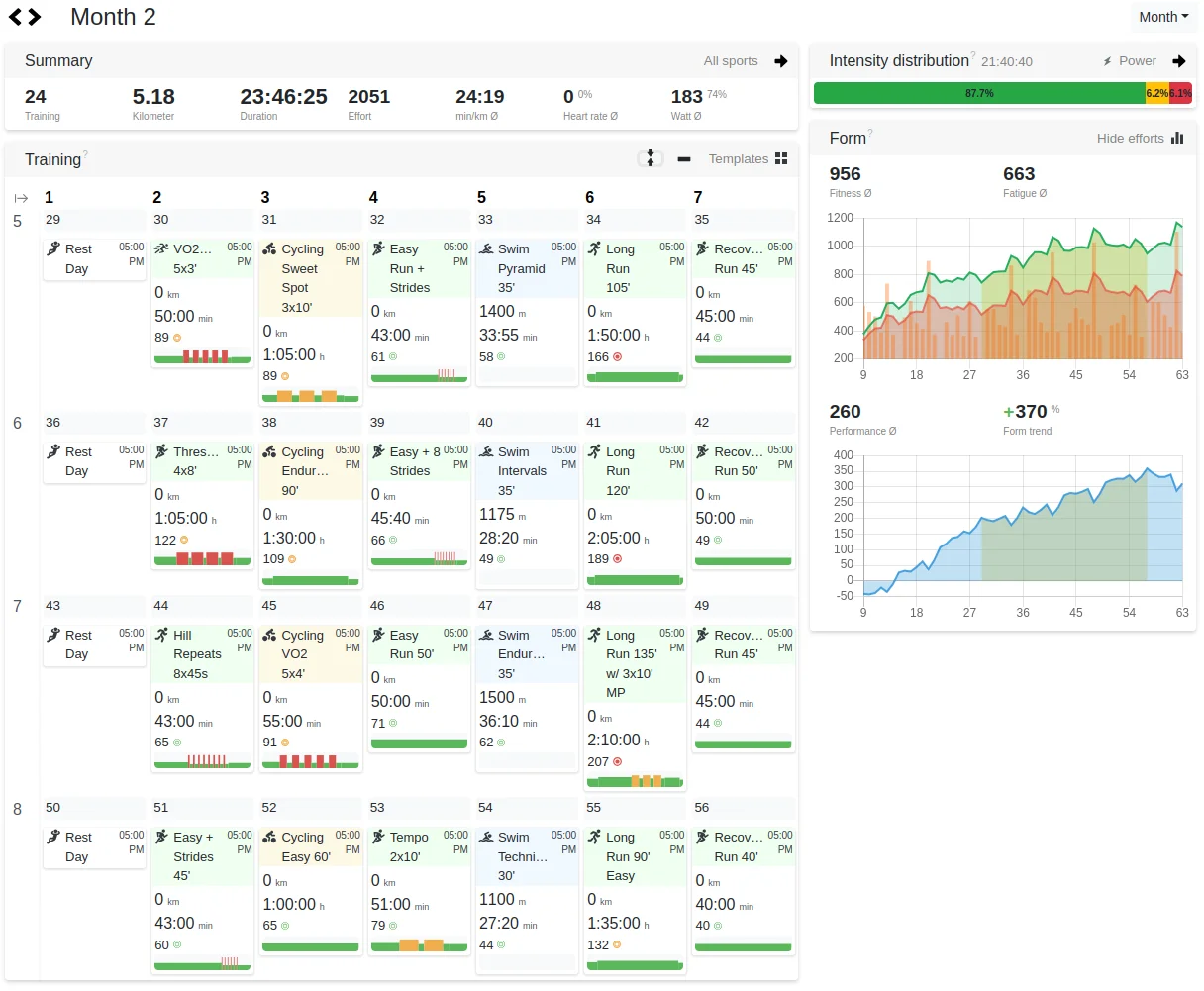
Looking at the result in Tredict, the distribution is what you would hope for. The second month sits at around 87% low-intensity work, which is a properly polarised build. The workouts are not cookie-cutter repeats, there is real variety across interval shapes and session types, and the swim and bike sessions include threshold segments rather than being filler. The long run progression is clean from 105 minutes in base phase through 150 minutes in the peak week, then a sensible taper.
The broader point
Claude Code was built for programming, which means it was built to hold large contexts and grind through long sequential tasks without losing track. That same property transfers cleanly to any job where you want an AI to look at a lot of data and produce a lot of structured output in one go. Training plan creation turns out to be exactly that kind of job.
Claude Web for the daily loop, Claude Code for the heavy lifts
Claude Web fits the daily rhythm. Analyse yesterday's session, plan the next week, adjust as you go. That conversational format is the right shape for ongoing coaching.
Claude Code fits when the task is too large or too systematic for a conversation. A full season plan, a bulk classification run over a year of activities, anything that wants a lot of data in and a lot of structured output out, in one sitting.
Who this is actually for
The terminal workflow is not for everyone, and it does not need to be. A few groups where it fits particularly well:
- Developers and technically inclined athletes who already work in the terminal day to day. Claude Code fits naturally into that setup.
- Coaches working with several athletes where stability and idempotency on large plans really count.
- Athletes who like to iterate and experiment. Trying different periodisation approaches, discarding a plan, regenerating it. The terminal loop makes that faster and more reproducible than a chat tab.
- Power users who want the full context visible: tool calls, responses, data in and data out, rather than tucked away behind a chat UI.
The Tredict connection guide for Claude Code covers the setup. Claude Code is a command line tool, so some comfort with a terminal is needed.
The previous article looks at why most AI training plans fall apart, and why the ones built on top of actual training data through MCP do not.
The next article goes the other direction and looks at Interactive MCP Apps, the Tredict widgets that render inline inside Claude.ai and ChatGPT instead of returning plain text.