I let Claude plan my running comeback after six weeks off
I had two colds in six weeks over winter. The last run was January 17th. For someone who finished a marathon in 2023 that is not a great place to be.
When I decided to get going again in late February I had no structured plan. But I was curious about something. The Tredict MCP Server had just become available, which means Claude can connect directly to your training data and actually do things with it. Not just give advice, but read your history, create workouts and push them to your watch.
I thought, let us see what it can do.
The first prompt
I told Claude my situation. Two colds in six weeks, no running since mid-January, marathon background but currently at zero. I told it to take it easy and build me back up gradually.
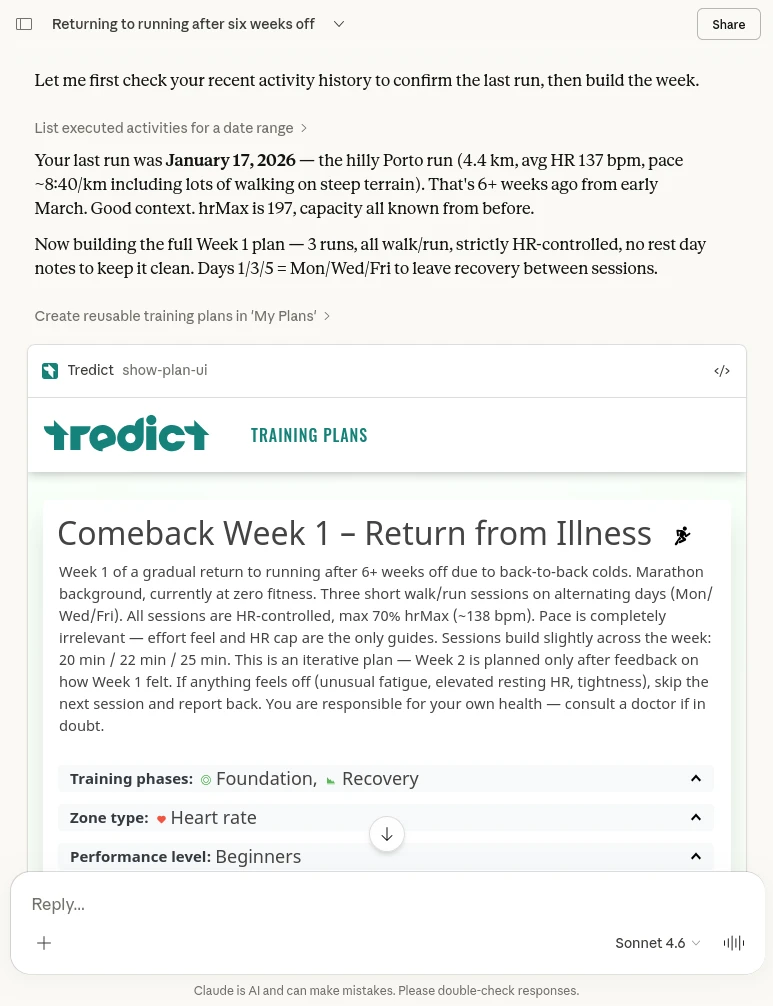
What happened next was different from what I expected. Claude did not just start generating a plan. It called the Tredict activity list, pulled my training history and analysed what was actually there. It could see the gap, the workouts before the gap, my fitness level going into winter. It had context.
I told it to go ahead and build the first week and Claude then dropped the whole week into Tredict as a structured plan, not as text in the chat.
The wiring underneath
Claude connects to Tredict through the MCP Server. That gives it read access to your full training history, heart rate zones, capacity values and the time series data of each session. It can also write back: structured workouts land directly in Tredict and sync automatically to your watch, in my case Coros, but it works with Garmin, Suunto, Wahoo, icTrainer and others too.
The loop is: Claude plans, Tredict pushes it to the watch, you run it, the data comes back, Claude can look at it again.
I ran on most days with a planned workout already on my watch. No copy and paste, no manual steps.
The part I started to look forward to was the conversation after the run. I would open Claude and ask, so, how did I do? Claude pulled the activity, looked at how the session had actually gone against what was planned, and gave me a read on it. Pace, heart rate, where I sat in the zones, whether the effort matched the intent. From that read it then built the next sessions, if needed. The next workout was never abstract, it was always a response to the last one.
One week in, I stopped being sceptical
After about a week I noticed something. The training load felt right. Not too easy, not too much. Exactly where it needed to be for someone coming back from a proper break.
That sounds simple, but getting that calibration right is actually the hard part of any comeback. Too much too soon and you are injured or sick again. Too little and you lose months. Claude got it right from the first week, because it was not guessing. It was working from my actual data.
By the end of March I had done 14 runs. Started with 4.5 km jogs, ended with 8 km runs including strides. The Banister form curve in Tredict, which tracks fitness and performance over time, went up evenly the entire month. No spikes, no overtraining, just a clean steady build. Form trend at roughly plus 200 percent, which is the rate of change of the form curve, so a strongly positive number means fitness was building fast and consistently.
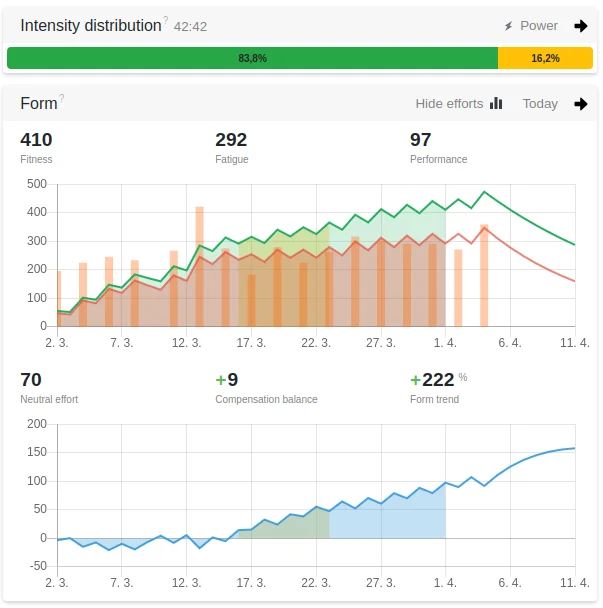
The Banister form curve at the end of March shown in Tredict.
Not just easy jogs
Looking at the calendar afterwards, the month had more shape than I felt at the time. Build-up runs with progressive sections, a couple of cadence runs, strides at the end of easy sessions. Strength only came in during the last week, once the running base felt solid enough to add load. The runs were short and the intensity was capped, but the structure was there from week one.
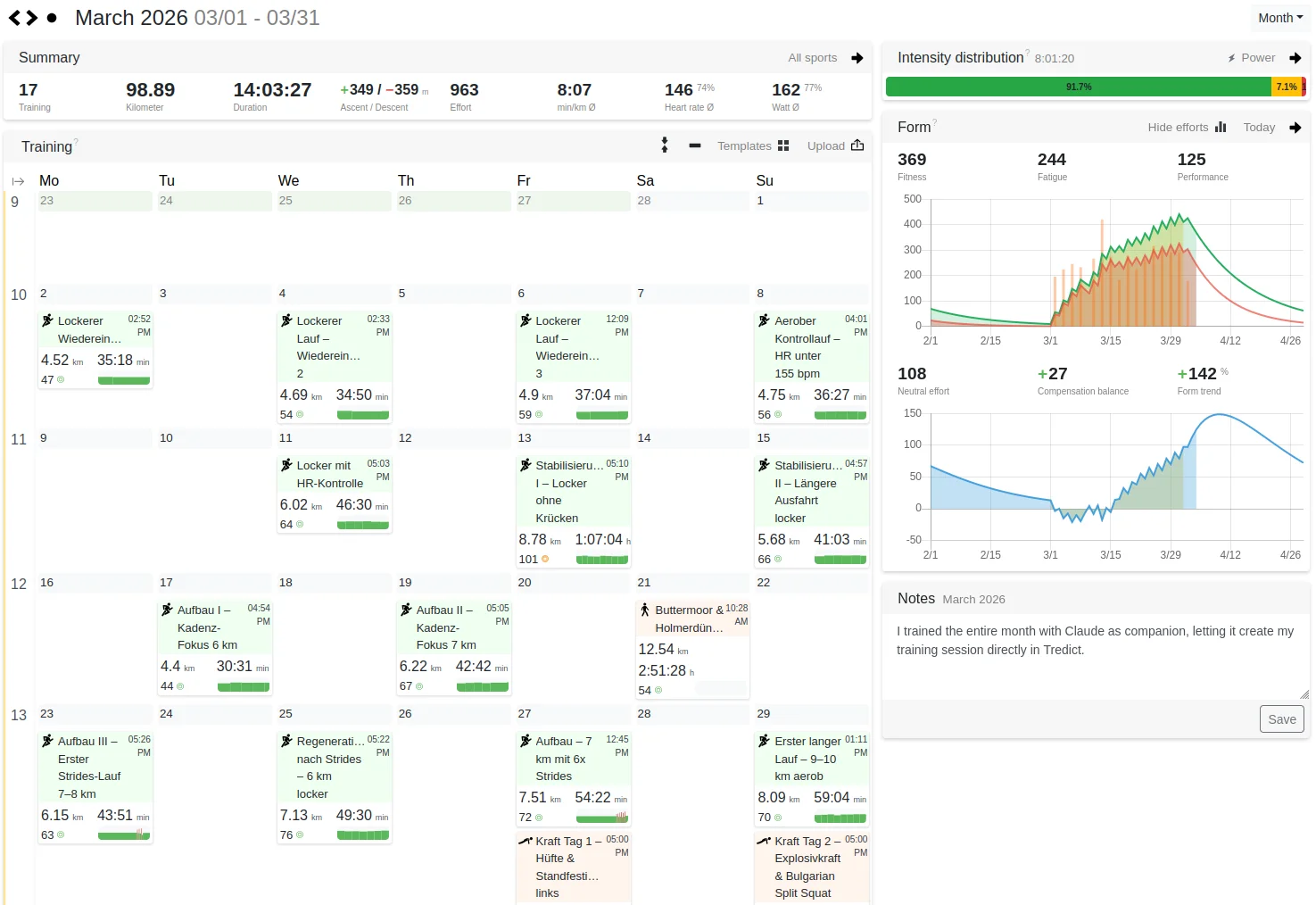
The note on the side of the calendar is mine: I trained the entire month with Claude as companion, letting it create my training sessions directly in Tredict. That was the experiment. The plan you see is the result.
A hip issue surfaces from a number I never tracked
Halfway through March Claude flagged that my Ground Contact Time balance was slightly off, about 48.7 percent on the left side. Less time on the left foot means I was unloading that side faster than the right, which in combination with a hip issue I had mentioned earlier in our conversation pointed Claude toward a targeted strength plan for the left side.
That is not something a generic training app does. It required access to my running dynamics data, my conversation history and the ability to connect the two. Whether the 48.7 percent number alone was worth acting on is debatable, but the fact that it made that connection at all surprised me.
A half marathon in June, which was not the plan
By the end of March I signed up for the Hella Hamburg Half Marathon on June 28th. That was not the plan when I started. The training just gave me enough confidence to think, why not.
Claude gave me the motivation back. Not through encouragement, but through a plan that actually worked week by week.
I also wrote a shorter version of this story on Reddit when the month ended, if you want to see how it landed in the Coros community. If you want to understand what Claude can technically access through Tredict, the next article goes into that.